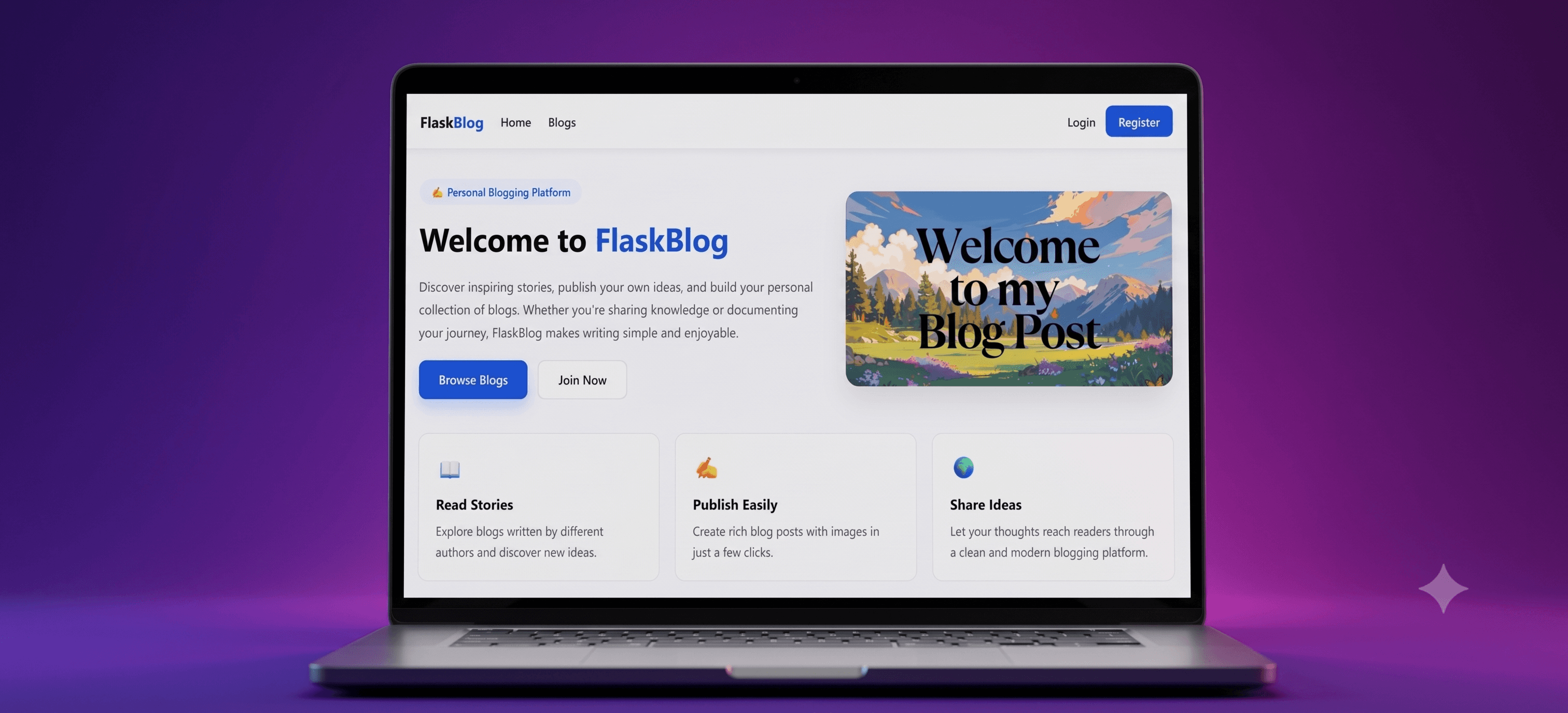
Flask Blog Application
A responsive blog management platform built with Flask that enables users to create, edit, organize, and manage blog posts with image uploads and persistent data storage.
Timeline
1 Week
Role
Full Stack Developer
Team
Solo
Status
CompletedTechnology Stack
Key Challenges
- Implementing image upload and file management for blog posts.
- Designing reusable Jinja templates to reduce code duplication.
- Managing CRUD operations while maintaining data consistency.
Key Learnings
- Built a complete CRUD application using the Flask framework.
- Gained practical experience with SQLAlchemy ORM and SQLite.
- Improved understanding of server-side rendering using Jinja2 templates.
Overview
Flask Blog Application is a lightweight full-stack blogging platform developed using Flask and SQLite. It allows users to create, edit, delete, and manage blog posts through a clean and intuitive interface while supporting optional image uploads for richer content.
The project was built to strengthen backend development fundamentals by implementing a complete CRUD workflow using Flask and SQLAlchemy. It demonstrates essential concepts such as server-side rendering, database integration, file handling, template inheritance, and responsive UI development.
The application is ideal for beginners learning Flask as well as developers looking for a simple blogging system that can be extended into a production-ready CMS.
Key Features
Core Features
- Complete CRUD Operations: Create, edit, update, and delete blog posts seamlessly.
- Image Upload Support: Upload images with blog posts and manage existing images while editing.
- Persistent Data Storage: Store blog content securely using SQLite with SQLAlchemy ORM.
- Automatic Timestamps: Track creation and modification dates for every blog post.
- Responsive User Interface: Clean and mobile-friendly interface built with HTML, CSS, and Jinja2 templates.
- Flash Notifications: User-friendly success and error messages after important actions.
- Template Inheritance: Reusable Jinja layouts for cleaner and maintainable frontend code.
Tech Stack
Frontend
- HTML5
- CSS3
- Jinja2 Templates
Backend
- Python
- Flask
- Werkzeug
Database
- SQLite
- SQLAlchemy ORM
Deployment
- Local Development Environment
Architecture
The application follows a traditional server-side rendered architecture.
- Client Browser → Flask Routes
- Flask Controllers → SQLAlchemy ORM
- SQLAlchemy ORM → SQLite Database
- Static Assets → HTML Templates → Browser Rendering
- Image Uploads → Local File Storage → Blog Posts
The application uses Flask routing for request handling, SQLAlchemy for database abstraction, and Jinja2 for dynamic page rendering.
Major Challenges
Managing Image Uploads
Handling uploaded images required validating files, storing them securely, displaying previews while editing posts, and allowing users to remove or replace existing images.
Solution
Werkzeug utilities were used for secure file handling, while Flask's static directory stored uploaded assets. Conditional rendering in Jinja2 allowed users to preview and manage images during updates.
Maintaining Reusable Templates
Building multiple pages without repeating HTML components became increasingly difficult as the project expanded.
Solution
Implemented Jinja2 template inheritance using a common base layout, enabling reusable navigation, styling, and shared UI components across all pages.
Database CRUD Operations
Ensuring accurate creation, updating, and deletion of blog posts while maintaining consistent database state.
Solution
Leveraged SQLAlchemy ORM to simplify database interactions, reducing raw SQL complexity and improving code readability and maintainability.
Performance Optimizations
- Used SQLAlchemy ORM for efficient database operations.
- Reused Jinja2 templates to minimize redundant rendering logic.
- Served uploaded images directly from the static directory.
- Reduced duplicated frontend code through template inheritance.
- Implemented lightweight server-side rendering for fast page loads.
Security
- Secure file uploads using Werkzeug.
- Server-side form validation.
- ORM-based database queries to minimize SQL injection risks.
- Flash messaging for safe user feedback.
- Input sanitization before storing user data.
Future Improvements
- User authentication and authorization.
- Rich text editor for writing blog posts.
- Search, filtering, and category support.
- Pagination for large collections of blogs.
- Comment system with moderation.
- REST API for third-party integrations.
- Cloud storage for uploaded images.
- Docker-based deployment.
What I Learned
- Developed a complete full-stack CRUD application using Flask.
- Built reusable server-rendered interfaces with Jinja2.
- Learned practical SQLAlchemy ORM workflows for database management.
- Improved understanding of file upload handling in Flask applications.
- Applied MVC-inspired project organization for better maintainability.
- Strengthened backend development fundamentals including routing, templating, and database integration.