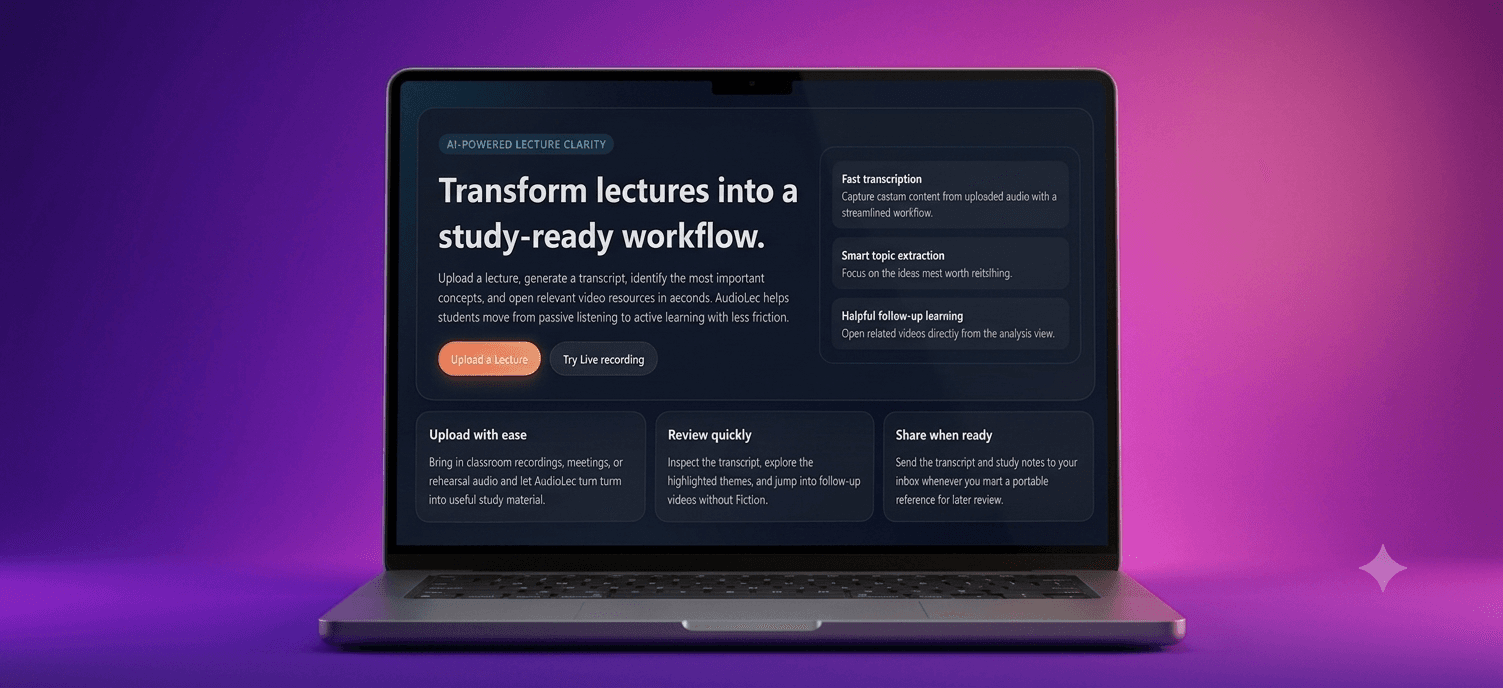
AudioLec
An AI-powered lecture assistant that converts recorded lectures into structured study material using speech recognition, NLP, and intelligent content recommendations.
Timeline
1 Week
Role
Full Stack Developer
Team
Solo
Status
CompletedTechnology Stack
Key Challenges
- Accurate speech-to-text transcription
- Extracting meaningful lecture topics using NLP
- Building an intuitive workflow for uploading and analyzing audio
Key Learnings
- Speech Recognition pipelines
- Natural Language Processing
- Flask application architecture
- Email automation
- Template rendering with Jinja2
Overview
AudioLec is an AI-powered educational web application designed to transform lecture recordings into structured learning material. Instead of manually revisiting long lecture recordings, students can upload audio files and instantly receive a transcript, AI-generated topic analysis, and recommended learning resources.
The application combines speech recognition, Natural Language Processing (NLP), and a responsive web interface to simplify revision and improve knowledge retention. Users can also share their generated analysis through email, making collaboration and note sharing effortless.
Key Features
Core Features
- Lecture Transcription — Convert uploaded lecture audio into readable text using Speech Recognition.
- AI Topic Extraction — Analyze transcripts with Google NLP to identify important concepts and entities.
- Smart Study Recommendations — Suggest relevant educational videos based on extracted lecture topics.
- Email Sharing — Send generated summaries and analysis directly via email.
- Responsive User Interface — Clean and mobile-friendly interface built using Flask templates and modern CSS.
- Fast Processing Pipeline — Streamlined workflow from audio upload to transcript generation and topic analysis.
Tech Stack
Backend
- Python
- Flask
Artificial Intelligence
- SpeechRecognition
- Google Natural Language Processing (Google NLP)
Frontend
- HTML
- CSS
- JavaScript
- Jinja2 Templates
Utilities
- SMTP Email Integration
- Environment Variables
- Virtual Environment (venv)
Major Challenges
Speech-to-Text Accuracy
Converting lecture recordings into accurate transcripts required handling varying audio quality, speaker accents, and background noise.
Solution
Integrated the SpeechRecognition library and optimized the transcription workflow to improve reliability across different lecture recordings.
Meaningful Topic Extraction
Raw transcripts often contain filler words and unnecessary information.
Solution
Leveraged Google Natural Language Processing to identify key entities and important concepts, producing concise and relevant study topics.
Smooth User Experience
The application needed to feel simple despite performing multiple backend operations.
Solution
Designed a clean upload-to-analysis workflow with responsive Jinja templates and intuitive navigation.
Performance Optimizations
- Efficient processing pipeline for uploaded audio files.
- Lightweight Flask architecture with modular route organization.
- Organized template rendering for faster page responses.
- Environment variable configuration for secure deployment.
- Reusable helper modules for email functionality.
Security
- Sensitive credentials stored using environment variables.
- Secure Flask secret key configuration.
- Separation of application logic and email credentials.
- Modular architecture for maintainability.
Future Improvements
- Support multiple audio formats.
- Add speaker diarization for multi-speaker lectures.
- Integrate Large Language Models (LLMs) for richer AI-generated summaries.
- Generate downloadable PDF study notes.
- Add user authentication and lecture history.
- Deploy the application using Docker and cloud infrastructure.
What I Learned
- Building AI-powered educational applications using Flask.
- Integrating Speech Recognition into production-ready workflows.
- Applying Natural Language Processing for information extraction.
- Structuring scalable Flask applications with reusable modules.
- Implementing secure email automation using environment variables.
- Designing user-friendly interfaces that simplify complex AI workflows.